What Is SynthID Bio?
AI systems are expanding beyond text and images into scientific fields. They can now help researchers propose biological molecules and proteins that might otherwise take far longer to explore. That progress creates a new question: when a biological design appears in a database or research workflow, how can people understand whether it was created by AI? SynthID Bio is Google's approach to that provenance problem.
What Is SynthID Bio?
SynthID is Google's family of technologies for identifying AI-generated content. It began with media such as images and has expanded to other digital formats. Rather than relying only on a label that a person can see, SynthID methods are designed to embed signals that compatible systems can verify.
SynthID Bio applies that idea to synthetic biology. Google describes it as a family of watermarking methods for biological designs, including AI-generated proteins. The goal is to add a provenance layer to biological outputs while preserving their biological function.
These hidden identifiers are not meant to be visible stamps on a protein sequence or predicted structure. They are intended to remain available to a verification process even when ordinary inspection would not reveal them. The public announcement does not expose every implementation detail, so the exact signal can depend on the method and version being used.
Why Does AI Biology Need Provenance?
A biological design can move through models, files, databases, publications, and laboratory workflows. Without a reliable way to describe where it came from, people may not know whether a design was produced by a model, edited by a researcher, or changed after generation.
AI provenance is the broader practice of recording and verifying that origin and history. Content authenticity asks whether a digital object is what it claims to be. Verification tests a signal, signature, or record so that a person or system can make a more informed judgment.
For AI biology, those concepts support traceability and can help protect scientific databases from becoming a mix of designs with unclear origins. They can also support biosecurity review by making the source of a design easier to investigate. Provenance is not the same as a safety guarantee, however. It supplies context that researchers can combine with other evidence and review processes.
Similar questions already appear in AI-generated images, video, audio, and text. In every case, people want to know where a piece of content came from, whether it was altered, and whether they can trust the context in which it appears.
How Does SynthID Bio Work?
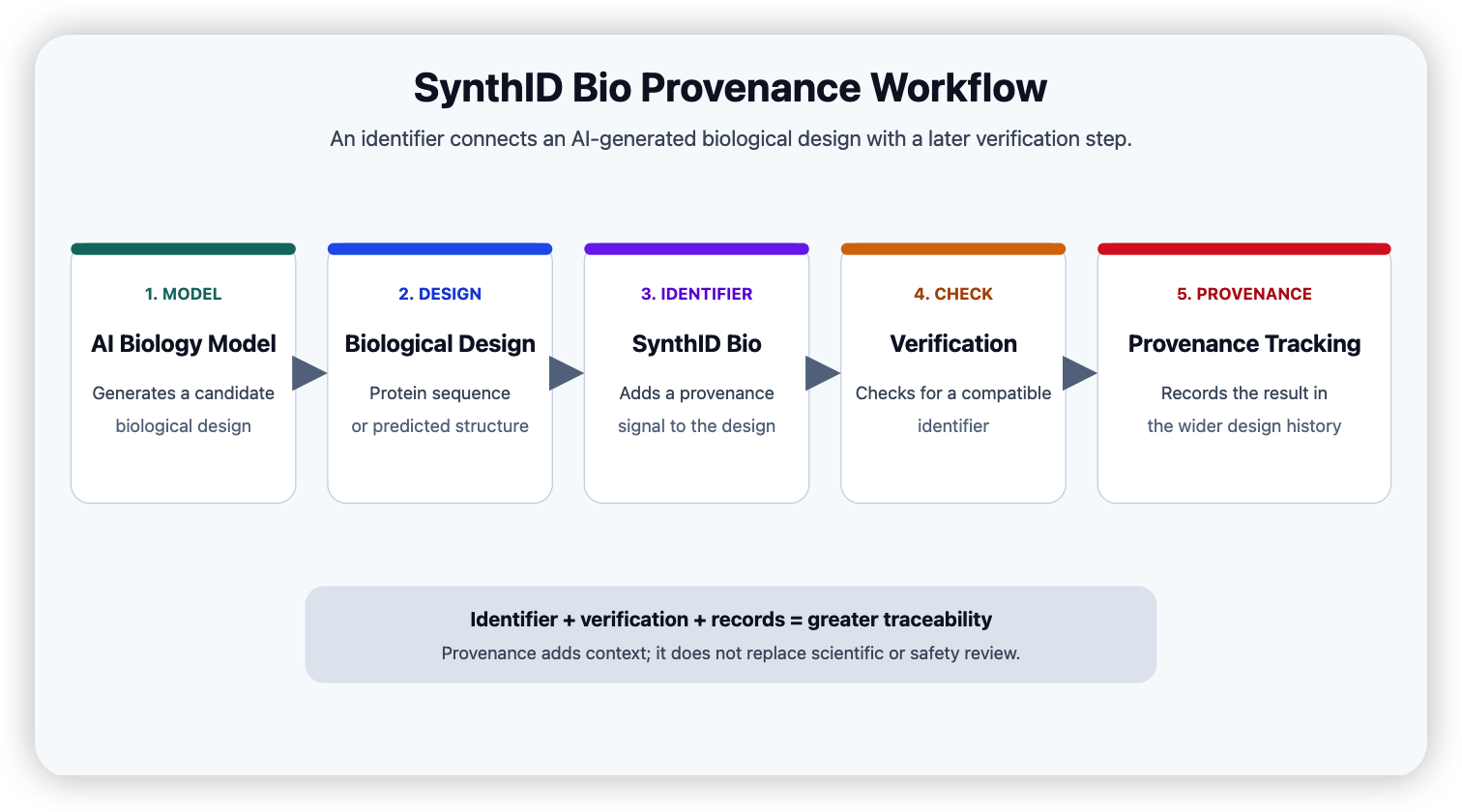
At a high level, the SynthID Bio workflow connects an AI biological model with a later provenance check:
- AI biology model: a model proposes or predicts a biological design.
- Generated biological design: the output may be represented as a protein sequence, a predicted 3D structure, or another scientific form.
- SynthID Bio identifier: a compatible watermarking method embeds or associates a provenance signal with the design.
- Verification: a verifier checks the design for a signal that matches the expected method.
- Provenance tracking: the result is recorded and considered alongside the design's wider history.
Google reports that laboratory tests found watermarked protein designs could retain function and natural diversity. Those results are an important part of the design goal, but a provenance signal does not replace scientific validation, laboratory safety, or human review.
A verification result also has limits. A detected signal can provide evidence about how a design was produced, while the absence of a signal does not automatically prove that AI was never involved. Verification depends on compatible methods and on the signal having survived the relevant workflow.
SynthID vs SynthID Bio
SynthID Bio is a specialized extension of the broader SynthID family. It shares the goal of identifying AI-generated output, but its subject matter and scientific context are different.
| Aspect | SynthID | SynthID Bio |
|---|---|---|
| Primary scope | AI-generated media | Biological AI designs |
| Typical context | Images and digital content | Scientific provenance |
| Core purpose | Content identification | AI biology tracking |
The distinction matters because a signal designed for an image is not the same thing as a signal designed for a protein sequence or structure. SynthID Bio extends the provenance idea into a scientific setting rather than replacing every other SynthID method.
Why AI Provenance Matters Beyond Biology
AI-generated content across different domains raises the same fundamental questions about origin, authenticity, and trust. Was an image created by a camera or generated by a model? Has a video been edited? Who published a document, and has its contents changed since it was created?
Technical identifiers can help answer part of those questions, but they work best as one part of a larger provenance system. That system may also include metadata, signatures, platform records, publication history, and human review.
Image URLs provide a useful comparison. A direct image address can show where an image resource is hosted and make it easier to retrieve, but the address alone does not prove who created the image or whether AI was involved. Our guide to what an image URL is explains that distinction between location and origin.
Does SynthID Bio Replace Traditional Metadata?
No. SynthID Bio adds an identifier and verification method; it does not replace every existing way of describing a scientific design.
- Metadata: structured information about a file or design, such as a creator, date, model, or description. Metadata is useful, but it can be incomplete or removed when a file is copied or converted.
- Visible watermark: a mark that people can see on the content itself. It provides an immediate signal, but it can be cropped, obscured, or intentionally removed.
- Invisible identifier: a signal embedded or associated with a design without changing how it normally appears. It can be checked by a compatible verification method.
- Provenance system: the wider process that records where something came from, how it changed, and what evidence supports those claims. It may combine identifiers, metadata, signatures, databases, and audit records.
Used together, these layers can provide more context than any one signal alone. SynthID Bio is best understood as a technology for adding verifiable provenance information to AI-generated biological designs, not as a complete replacement for scientific records or human judgment.
Frequently Asked Questions
What is SynthID Bio?
SynthID Bio is Google's family of watermarking methods for AI-generated biological designs, including proteins. It is intended to provide a verifiable provenance signal without changing the biological function of the design.
Who created SynthID Bio?
Google created SynthID Bio. Google announced the technology in September 2026 as part of the broader SynthID family.
Is SynthID Bio a visible watermark?
No. It is described as an imperceptible, verifiable identifier rather than a visible label written across a biological sequence or structure.
Why does AI-generated content need provenance?
Provenance helps people understand where content or a design came from, how it was created, and whether it has changed. For biological designs, that traceability can support scientific database integrity and biosecurity review.
Is SynthID Bio related to AI image watermarks?
Yes. SynthID Bio belongs to the same SynthID family as Google's watermarking technology for AI-generated media, but it is adapted to biological designs rather than image files.